
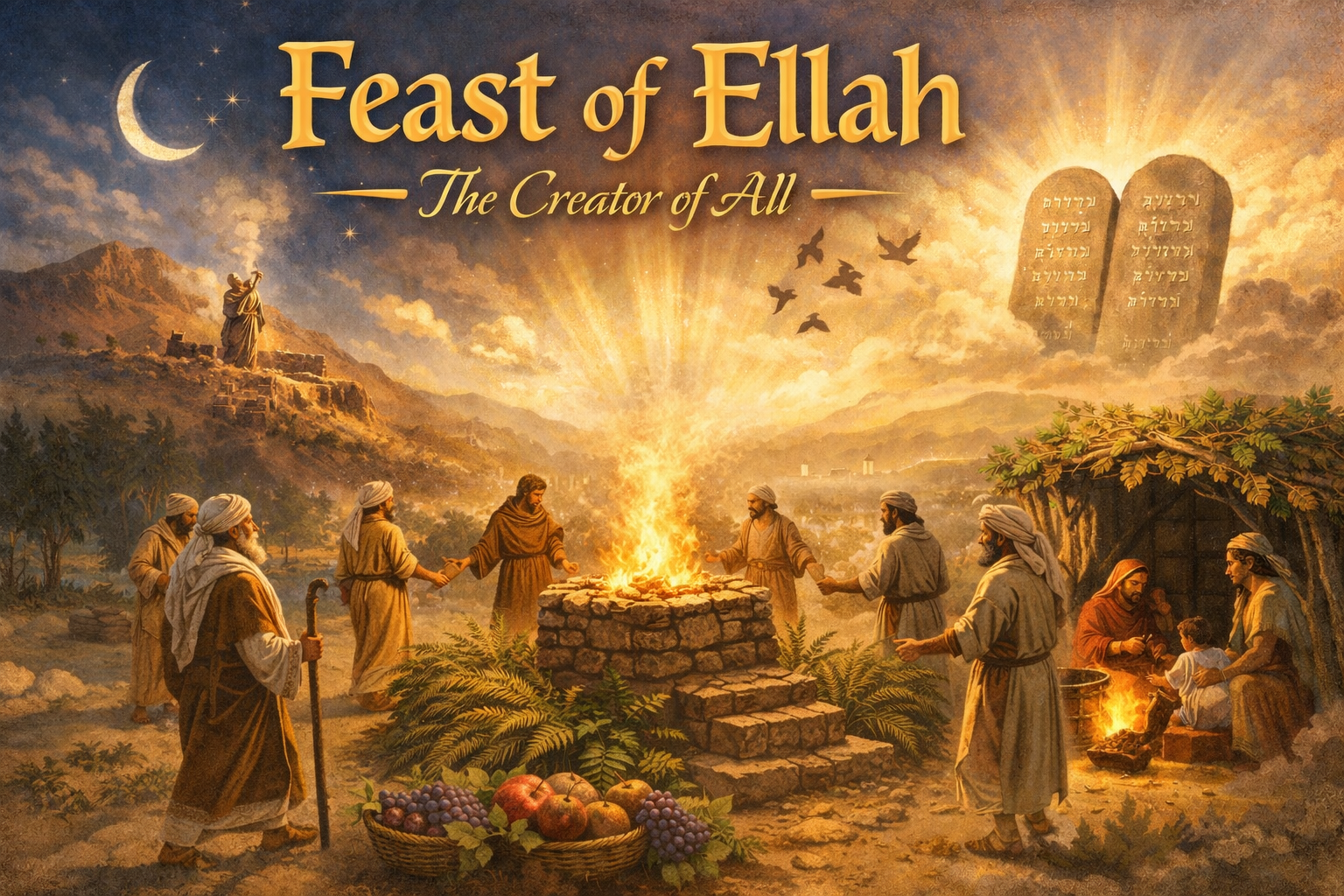
The feasts traced to Abraham are not national institutions, nor do they originate with Israel as a people. They precede Sinai, precede Mosaic legislation, and therefore cannot be properly classified as “Jewish festivals.” They are best understood as Feasts of Ellah — the Creator of All: divinely appointed times rooted in the created order and transmitted through Abraham to all his descendants.1
This framework is essential for reading the Qur’an correctly. When the Qur’an speaks of pilgrimage, sacred months, and appointed times, it does not present them as innovations. It functions as a reminder and a confirmer, re-anchoring Muhammad’s mandate within an already existing Abrahamic path rather than replacing it.2
Firstfruits and Harvest as Calendar Witness (Sirach & Qur’an)
The offering of firstfruits is not a symbolic abstraction; it is a calendar claim. Firstfruits presuppose harvest. Harvest presupposes seasons. Seasons presuppose a structured year. This logic is assumed—not argued—in Sirach 7:29–31, where honoring God is tied to giving the priest his due portion “as you have been commanded,” explicitly including firstfruits.3
The Qur’an confirms the same creation-grounded logic of obligation:
“Eat of their fruit when they bear fruit, and give its due on the day of harvest.” (Q 6:141).4Duty arises when harvest occurs, not from an abstract date detached from the land.
New Moons as Appointed Times — and for Pilgrimage
The Qur’an makes the calendar function explicit by pairing lunar markers with pilgrimage:
“They ask you about the new moons. Say: they are appointed times (mawāqīt) for people and for the Pilgrimage (al-Ḥajj)….” (Q 2:189).5Pilgrimage is therefore assumed as part of a known sacred-time structure, not introduced as a new ritual system.
Not an Islamic Novelty: the Semitic Festival Root (ḥ-g-g / ch-g-g)
Even the very language of pilgrimage-feasts points away from object-centered ritual and toward cyclical, seasonal return. In Semitic usage, the Hebrew root ח-ג-ג (ch-g-g) and the noun חַג (chag) denote a festival that comes around again—a recurring appointed time marked by movement, celebration, and communal gathering.6
This semantic field aligns naturally with the Qur’anic language of mawāqīt (appointed times), with harvest-based obligation, and with the Abrahamic pattern of seasonal worship. In other words, the linguistic substrate supports reading these feasts as returning sacred cycles rooted in creation, rather than rites anchored to a later fixed object.
Abrahamic Feast Structure Preserved in Jubilees
The Book of Jubilees preserves what the Torah often leaves implicit: Abraham as the guardian of divinely appointed times transmitted to multiple lineages.1 Within this framework, three major feast-events emerge, each bearing pilgrimage characteristics: movement toward a sacred act, covenantal renewal, and creation-rooted timing.
Akidah — the Foundational Pilgrimage
In Jubilees 17–18, the Akidah is presented as a structured covenantal act: a commanded journey, a designated place, an altar, and sacrificial obedience.7 It establishes the primordial pilgrimage pattern: departure → sacred place → offering → covenantal affirmation.
Shavuot — Feast of Weeks and Firstfruits
In Jubilees 6:15–22, the Feast of Weeks is tied to covenantal structure and described as an ordinance written on the heavenly tablets.8 Its universal character is made explicit in Jubilees 22:1, where Isaac and Ishmael celebrate together with Abraham the feast of the firstfruits of the harvest.9
Tabernacles — Dwelling, Completion, and Return
Jubilees also associates Abraham with seasonal dwelling patterns aligned with what later appears as Tabernacles (Sukkot), highlighting temporary habitation, completion of the agricultural cycle, and return to sacred time year after year (see Jubilees 16 and related Abraham passages).10
Universal Scope: One Path, Many Nations
Abraham transmits this covenantal path not to a single nation, but to Isaac, Ishmael, and the sons of Keturah alike (see Jubilees 20), commanding righteousness, justice, moral restraint, and exclusive devotion to the Most High.11 This background explains why the Qur’an commands Muhammad: “Follow the way of Abraham.” (Q 16:123).12
Sacred history is framed in universal terms:
“Bring your people out from darkness into the light, and remind them of the Days of Ellah.” (Q 14:5).13These “Days” are divinely appointed moments of covenant, judgment, and renewal—belonging to the Creator of all, not to one people alone.
Conclusion
Read together, Sirach, Jubilees, and the Qur’an converge on a single conclusion: the feasts are seasonal, cyclical, and covenantal. They originate with Abraham before Israel, are preserved across generations, and are reaffirmed by the Qur’an as part of a creation-rooted order of sacred time. They are therefore best understood as Feasts of Ellah — The Creator of All.
Footnotes
-
Book of Jubilees (Second Temple Jewish text). For Abraham and appointed times, see especially Jubilees 16; 17–18; 20; 22. ↩
-
On the Qur’an’s self-presentation as reminder/confirmation and Abrahamic anchoring, compare Qur’an 16:123 with Qur’an 14:5, alongside the pilgrimage-calendar coupling in Qur’an 2:189. ↩
-
Sirach (Ben Sira), 7:29–31 (honor of God/priesthood; firstfruits and holy portions “as commanded”). ↩
-
Qur’an 6:141 (“give its due on the day of harvest”). ↩
-
Qur’an 2:189 (new moons as mawāqīt for people and for ḥajj). ↩
-
Hebrew חַג (chag) “festival/feast,” and חגג (chagag) “to keep a pilgrim-feast / celebrate,” attested across Hebrew usage; consult standard Hebrew lexica (e.g., BDB; HALOT) and concordance contexts for pilgrimage-feast terminology. ↩
-
Jubilees 17–18 (Akidah as commanded journey, altar, and covenantal obedience). ↩
-
Jubilees 6:15–22 (Feast of Weeks / firstfruits; ordinance language; heavenly tablets framing). ↩
-
Jubilees 22:1 (Isaac and Ishmael celebrate the Feast of Weeks—firstfruits of harvest—with Abraham). ↩
-
Jubilees 16 (and related Abraham passages) for seasonal dwelling/completion motifs aligned with Tabernacles (Sukkot). ↩
-
Jubilees 20 (Abraham gathers Ishmael, Isaac, Keturah’s sons; commands “the way of the Lord” with righteousness/justice and covenant fidelity). ↩
-
Qur’an 16:123 (“Follow the way of Abraham…”). ↩
-
Qur’an 14:5 (“remind them of the Days of Ellah”). ↩