Sun, Moon, and the Stars
The Calendar from Creation to the Qur’an: Structure, Signs, and Sacred Time
Introduction: Why This Topic Is Foundational
Within the biblical and Qur’anic textual corpus, time is not presented as a merely human convention, but as a structured reality in which the heavenly luminaries function as signs (’ōth) and as the basis for moʿedim—named appointments,
convocations, and recurring “meetings.” In Genesis 1:14, the calendar is framed primarily as a system of cosmic signaling for sacred terms and memorial points, rather than a neutral astronomical tool.
In that framework, the Qur’an often reads as concise because it does not redraw a full calendar-table from scratch, but speaks in a mode of confirmation and continuity. Its structural expressions—“known days,” “known months,” “four sacred months,” and “the new moons as mawāqīt”—do not operate as novel definitions, but presuppose an already established framework of sacred time grounded in signs (’ōth) and named appointments/meetings (moʿedim).1
1) Time Before “Astronomy”: First Day/Night
Before the Sun and Moon are assigned their governing roles, Genesis introduces the most basic unit of time through the differentiation of light and darkness:
“God called the light Day, and the darkness He called Night.” (Genesis 1:3–5)
Time, therefore, emerges as:
- light / darkness,
- counting (“evening and morning”),
- and only afterward receives its “heavenly governors.”
This order implies a central idea: astronomy does not create time; it structures and measures it.
2) The Seventh Day: Cessation (šāvat), Not “Fatigue”
In Genesis 2:2–3, the key notion is not divine exhaustion, but the verb šāvat—to cease, to stop, to desist. The seventh day introduces the first rhythmic interruption (a reset) in the flow of time.
Accordingly, the seventh day functions as:
- a structural boundary,
- a sanctified cessation of labor,
- not a claim about divine weariness (explicitly denied in Isaiah and in the Qur’an).
This principle matters because later prophetic texts do not reduce sacred time to “one weekly Sabbath,” but present a broader system of sacred points.
3) Sun, Moon, and Stars: Role and Hierarchy
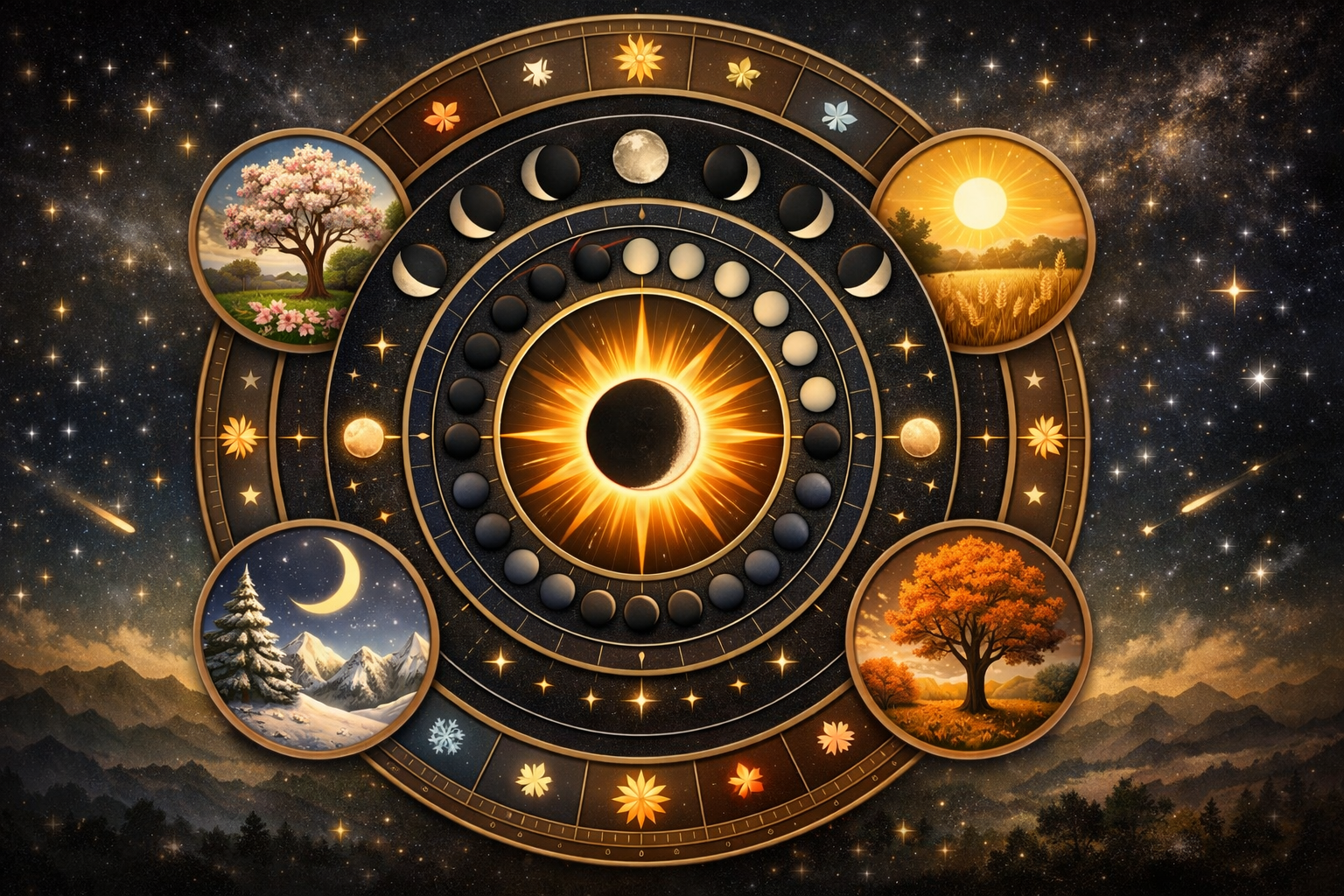
Genesis 1:14–18 states that the heavenly lights were given:
“…to be for signs, and for appointed times (moʿedim), and for days and years.” (Genesis 1:14)
This establishes a hierarchy of functions—distinct yet interrelated—by which sacred time is organized.
Sun
- governs the day,
- carries the annual course and the seasonal cycle,
- marks the turning points of the year (day-length / night-length), which earlier traditions associate with memorial points of the cosmic cycle.
Moon
- governs the night,
- enables the reckoning of months,
- and—crucially—is tied to moʿedim: named and appointed terms (including the weekly Sabbath, seasonal feasts, and pilgrimage periods).
This lunar function is explicitly affirmed in Psalm 104:19, which states that the moon was made “for moʿedim.”
Stars
- serve as orientation markers,
- preserve “stations” (seasonal positions and navigational points).
The Qur’an notably highlights their guiding role through the darkness of land and sea (e.g., Qur’an 6:97).
4) The Moon “for Moʿedim”: Weekly and Seasonal Sabbaths Within a Lunar Order
A foundational textual nexus in the Tanakh reads:
“He made the moon for moʿedim; the sun knows its setting.” (Psalm 104:19)
In Leviticus 23:3, the weekly Sabbath is explicitly defined as a moʿed—a sanctified, named appointment marked by cessation of work and convocation.
A structural consequence follows: if the moon is made “for moʿedim,” and the Sabbath is a moʿed, then the weekly Sabbath cannot be isolated from the lunar order. Rather, it is positioned within a sacred-time system in which the moon establishes the framework and signal-points by which named appointments appear and “re-align.”3
In this system, the moon does more than enable the counting of months: it establishes a lunar rhythm in which weekly Sabbaths and seasonal/feast Sabbaths occur. Hence, certain dates (for example, the fifteenth day of a month in the feast cycle) can function simultaneously as a weekly Sabbath and as a feast-Sabbath, without textual contradiction.
5) New Moon and Sabbath: Two Distinct Yet Related Sacred Points (Ezekiel 46)
Ezekiel 46:1 makes a clear distinction between:
- six working days,
- the Sabbath,
- and the day of the New Moon (the first day of the month).
This threefold division shows that the New Moon is neither an ordinary working day nor identical with the Sabbath. It is a distinct monthly marker of sacred time.
At the same time, the text presupposes that the weekly rhythm of labor and rest unfolds within a lunar framework defined by the New Moon. In this model, the New Moon functions as a calendrical boundary and signal-point: it belongs to the counting of the month, but it is not counted among the numbered working days of the week.4
6) Ben Sira (Sirach) 43: The Moon as a Signal for Sacred Terms
Ben Sira explicitly confirms the same calendrical logic:
“He made the moon to mark the changing seasons…
From the moon we calculate when feast days are to be observed…
‘Month’ derives its name from the moon…” (Sirach 43:6–8)
Here the moon is not a decorative ornament, but a functional instrument of sacred time—a signal-marker for named appointments.
7) The Qur’an: Structure Rather Than Catalogue (Confirmation, Not Repetition)
The Qur’an does not present sacred time as an exhaustive calendar-table, but through structural axes that presuppose an existing framework. Rather than re-listing names and details, it repeatedly uses referential terms marked as “known” and already established.
7.1 Twelve Months and Four Sacred Ones
“Indeed, the number of months with God is twelve—since the day He created the heavens and the earth—of them four are sacred.” (Qur’an 9:36)
Sacred months are framed as a cosmic ordinance, not a late institutional innovation. The condemnation of calendar-postponement (nasīʾ) in Qur’an 9:37 further implies that tampering with sacred time constitutes an increase in deviation/error.2
Notably, the Qur’an does not name the four sacred months. Within the text’s own logic, this is best read not as vagueness, but as continuity: the Qur’an does not reconstruct the calendar from zero; it confirms and disciplines an already known sacred-time order.
7.2 The New Moons as Mawāqīt
“They ask you about the new moons. Say: they are appointed times (mawāqīt) for people and for pilgrimage (ḥajj).” (Qur’an 2:189)
This statement directly ties:
- the new moons (al-ahillah),
- appointed times (mawāqīt),
- and ḥajj.
Functionally, this aligns with the Tanakh’s “moon for moʿedim,” expressed in Qur’anic terminology.
8) Ḥajj in the Qur’an: “Known Months” (Plural)
“Al-ḥajju ašhurun maʿlūmāt.” (Qur’an 2:197)
The plural “months” does not support reducing ḥajj to a single month or a single terminal window. The Qur’an speaks in a referential mode—“known months”—consistent with its broader style (cf. Qur’an 22:28).
9) Harvest and Ḥaqq: A Festal Obligation Without Naming the Feast
“Eat of its fruit when it yields, and give its due (ḥaqqahu) on the day of its harvest (yawm ḥaṣādihi)…” (Qur’an 6:141)
This verse combines two precise components:
- a temporal marker: “the day of harvest,”
- a normative marker: ḥaqq—a due portion/obligatory right.
The structure “appointed time + obligation” reflects the logic of sacred-time systems: a marked term is not merely seasonal, but communally and normatively defined.
10) Four Sacred Months (Noah) ≠ Ḥajj-Months (Abraham)
A crucial distinction must be maintained: the sanctity of “four months” and the institutional pilgrimage pattern do not belong to the same category, nor do they arise from the same covenantal layer.
10.1 Noah: Four Seasonal Points as Memorial Feasts (Jubilees)
The Book of Jubilees teaches that four key points of the year—new moons of the 1st, 4th, 7th, and 10th months—were established as memorial days tied to flood events and the division of the year.
10.2 Abraham: Pilgrimage Pattern, Covenant Rhythm, and Feasts Before Moses (Jubilees)
Jubilees then presents a distinct covenantal line connected with Abraham: covenant rhythm, feasts such as Weeks (Shavuot) and Tabernacles (Sukkot), and seven-day festal patterns. These are not cosmic memorials of Noah’s flood chronology, but covenantal and cultic patterns attributed to Abrahamic practice.
Therefore, “four sacred months” does not automatically mean “four ḥajjs.” The Qur’an can confirm the existence of four sacred months (9:36) and speak of ḥajj occurring in “known months” (2:197) without collapsing these categories into one.
11) Why These Feasts Are Not “Jewish” in Their Earliest Layer (Except Passover)
This distinction must be made strictly textually:
- Passover (Exodus) is directly tied to Israel’s national-historical deliverance under Moses and functions as a specific identity-marker.
- By contrast, Jubilees presents feasts such as Weeks and Tabernacles as present in Abrahamic practice prior to Moses.
In that sense, Passover is anchored to Israel’s historical identity, whereas certain pilgrimage/seasonal patterns are presented as older—Abrahamic—and thus potentially universal at their source.
12) Abraham, Tabernacles, and the Pattern of “Circling” (Jubilees)
Jubilees includes a detailed description of Abraham’s celebration of Tabernacles, including:
- building booths,
- taking branches and “fruit of goodly trees,”
- a seven-day festal framework,
- and a liturgical pattern of circling the altar seven times daily during the feast days.
The relevance here is strictly textual: circling a sacred center is not necessarily a late ritual development, but appears in the Abrahamic festal idiom in Jubilees.
13) “The House of Abraham”: Textual Location and Covenant Identity (Jubilees)
Jubilees does not present “the House of Abraham” as an abstract symbol. The narrative is concrete: it associates Abraham with a specific locale and with the act of building an altar and “house,” and frames that site in covenantal terms (especially Jubilees 16; 18; 22).
In this reading, stating what Jubilees actually says does not require harmonization with later traditions. The Qur’an’s first mention of a sacred place using the term Bakka without topographical detail remains a textual question, but it does not contradict the Jubilees narrative logic: the Qur’an confirms the covenantal framework while leaving narrative geography largely unexpanded.
14) Tabernacles as a Universal Feast (Zechariah 14:16–19)
“All who are left of all the nations… shall go up year after year… to keep the Feast of Tabernacles… and if any… do not go up… on them there shall be no rain.” (Zechariah 14:16–19)
This prophetic text portrays Tabernacles as transcending ethnic boundaries and carrying a universal dimension—consistent with Jubilees’ explicit attribution of its origin to Abraham’s covenantal framework.
15) The Akedah and Seven Days: An Abrahamic Festal Pattern (Jubilees)
Jubilees presents the Akedah not as an isolated instant but within a structured temporal sequence: command → multi-day journey → arrival at a specified place → ritual act, followed by a seven-day festal frame.
The comparison “Akedah + seven days” versus “Passover + seven days” can be treated as a structural parallel: Jubilees preserves an Abrahamic festal idiom prior to Moses, while Passover in the Mosaic covenant is explicitly tied to Israel’s Exodus identity.
16) Why the Qur’an Does Not Provide a List
The Qur’an establishes a coherent sacred-time framework through several central statements:
- twelve months, four sacred (9:36),
- new moons as mawāqīt for people and for ḥajj (2:189),
- ḥajj in “known months” (2:197),
- “known days” for remembrance (22:28),
- and a normative due portion (ḥaqq) on the day of harvest (6:141).
Taken together, these are not fragments but a network of temporal references operating within a previously established covenantal framework. The absence of an explicit list therefore need not be read as a deficiency, but as a feature of a confirmatory discourse: the Qur’an confirms and normatively stabilizes a known sacred-time order rather than rewriting earlier catalogues in tabular form.
17) The Kolbrin as a Comparative Witness (Stations, Seasons, Measures)
The Kolbrin passages used here function as comparative attestations of the same cosmic view of time:
- knowledge of seasons, the moon, and “the Book of Heaven” (GLN:4:14),
- moon and sun maintaining appointed seasons and stations; stars retaining their stations (MAN:34:67),
- weeks receiving numbering, the coming of the moon being known, and four divisions of the year (OGS:6:11),
- rest measured “from the hour of darkness beginning the seventh day…” (SOF:20:31).
In comparative analysis, these citations support the same basic pattern: sacred time is anchored in cosmic cycles and “stations,” not merely in social convention.
Conclusion: A Unified Map of Sacred Time
When these textual layers are read together, a coherent and continuous model of sacred time emerges:
- time is established in the act of creation (Genesis 1),
- the seventh day signifies cessation (šāvat), not divine fatigue (Genesis 2),
- the moon is made “for moʿedim” (Psalm 104:19),
- New Moon and Sabbath are distinct sacred points within the temporal structure (Ezekiel 46:1),
- Ben Sira confirms the moon as an instrument for reckoning feasts (Sirach 43),
- the Qur’an confirms twelve months and four sacred ones, and ties the new moons to mawāqīt and ḥajj (9:36; 2:189; 2:197; 22:28; 6:141),
- Jubilees clarifies the Noahic logic of four seasonal memorial points and an Abrahamic festal idiom,
- Zechariah affirms the universal horizon of Tabernacles (Zech 14:16–19).
In that order, the Qur’an is not “incomplete,” but structurally consistent: it speaks in terms of framework and relations because it relies upon an already established sacred-time mechanism—one it does not abolish or redundantly rewrite, but confirms and normatively orients.
Footnotes
- On “signs” and “appointments.” Genesis 1:14 uses ’ōth (אות) and moʿedim (מועדים). In standard lexicography (e.g., BDB), ’ōth includes “sign/signal” and can include the sense of a memorial/token; moʿed denotes “appointed time/place,” including sacred seasons and convocations. ↩
- On nasīʾ (calendar postponement). Qur’an 9:36–37 frames the twelve-month order as established “since the day He created the heavens and the earth,” and condemns nasīʾ as an “increase” in deviation/error—indicating that manipulating sacred time is a violation of the created temporal order. ↩
- Moon, moʿed, and Sabbath. Psalm 104:19 (“moon for moʿedim”) and Leviticus 23:3 (weekly Sabbath as a moʿed) together anchor the argument that the weekly Sabbath appears within a sacred-time framework in which lunar markers provide the calendrical scaffolding for named appointments. ↩
- Ezekiel’s distinction. Ezekiel 46:1 distinguishes “the six working days,” “the Sabbath day,” and “the day of the New Moon,” indicating two distinct sacred points within a monthly frame. This supports the claim that New Moon belongs to month-reckoning while remaining distinct from the numbered working-day sequence. ↩