Flood, Time, and Knowledge
Introduction: When the Texts Are Not Saying the Same Thing
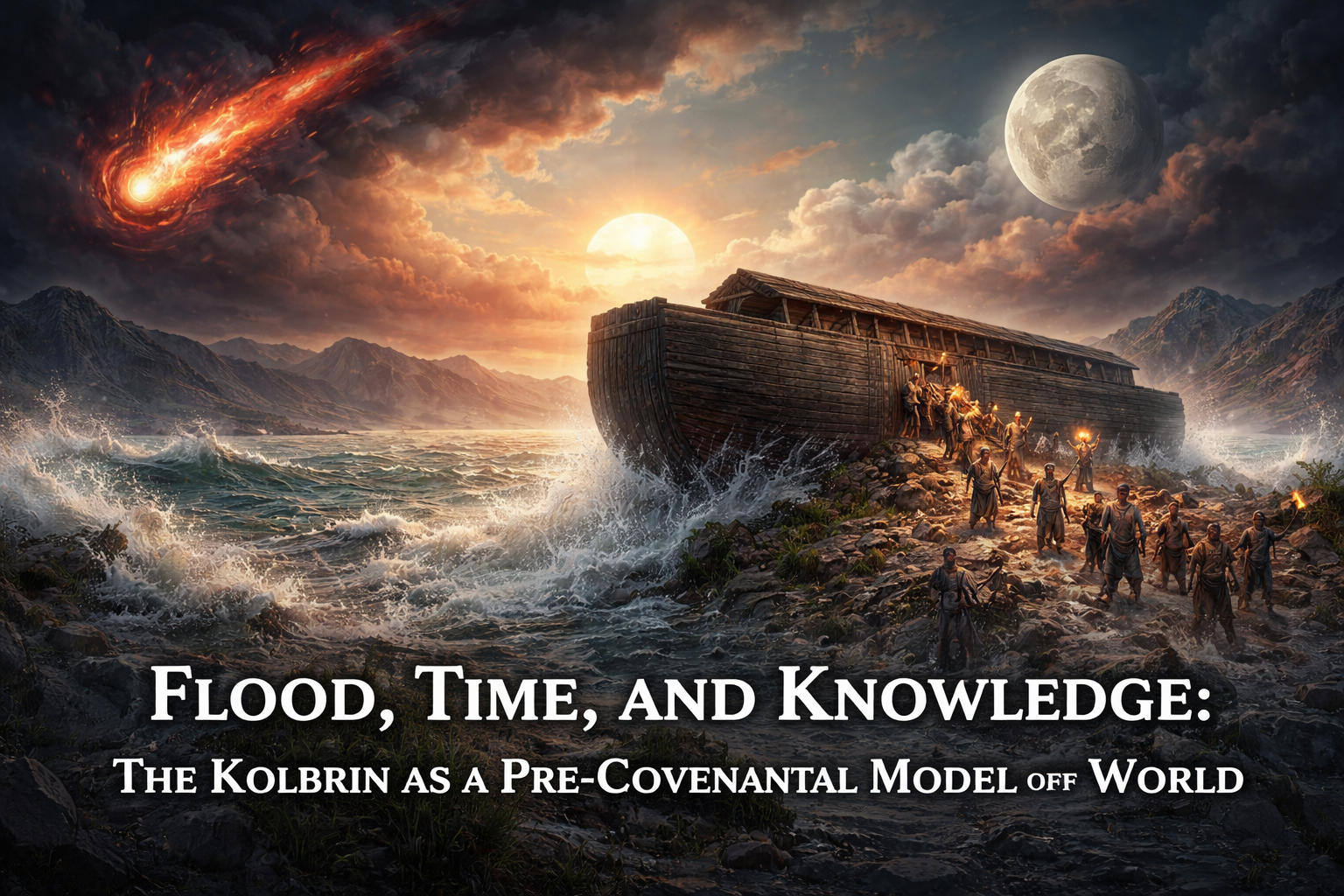
Flood narratives are often treated as variations of the same story. But a close reading shows that the differences are not superficial; they are structural: what causes the catastrophe, what is being preserved, and what is required to rebuild the world.
In the Torah’s frame, the Flood is presented primarily as a moral judgment and a turning point into covenant history: “The LORD saw that the wickedness of man was great…” (Genesis 6:5).1 In the Kolbrin, the Flood is described as a cosmic rupture tied to cycles and disruption. Human moral collapse and covenant-breaking are described as the condition of the world at that time, while preservation centers on the knowledge necessary for civilization to continue.
This article does not attempt to “prove” any text as ultimate truth. Its aim is simply to compare the internal logic and structure of the passages themselves.
1) Time as the Infrastructure of the World (OGS 6:11)
The Kolbrin explicitly describes the establishment of organized time:
“These were the times, when days received their names and weeks their numbering. The coming of the moon was made known, and daylight was divided into four parts… Men knew the four divisions of the year, and their names were known.” 2
This is not an account of ritual; it is a description of a system. Days have names, weeks have numbering, the Moon’s arrival is known and publicly announced, day and night are functionally divided, and the year is divided into four recognized parts. In other words: a complete calendrical framework.
In Genesis, time is foundational in creation (“for signs and seasons, and for days and years,” Genesis 1:14),3 but the Flood narrative itself does not focus on calendrical mechanics; it foregrounds Noah’s righteousness and obedience.
2) Cyclical History and the Destroyer (CRT 7:5)
The Kolbrin presents time as cyclical:
“He taught them the mysteries concerning the wheel of the year… and divided the year into a Summer half and a Winter half, with a great year circle of fifty-two years… the circle of The Destroyer.” 4
The passage introduces multiple layers of time: a seasonal year (summer/winter halves), a larger 52-year cycle, and an even larger cycle associated with “The Destroyer.” In the broader Kolbrin framework, the Destroyer is treated as a cosmic disruptor—an event or agent that disturbs the order of the heavens and the earth—so catastrophe is framed as cosmic disruption rather than a juridical act of moral sentencing.
Genesis, by contrast, states the cause in moral terms (Genesis 6:5),1 and the narrative proceeds as a singular act of judgment rather than a recurring cosmic cycle.
3) Who Enters the Ship—and What Is Most Important (GLN 4:23)
One of the sharpest contrasts appears in the Kolbrin’s description of those preserved:
“Of all the people who entered with him, two understood the ways of the sun and moon and the ways of the year and the seasons.” 5
This is listed first—before crafts, food production, music, building, and administration. The implication is direct: knowledge of the Sun, Moon, year, and seasons is foundational for rebuilding the world. Without it there is no stable planting and harvesting, no planning, no coordination, and no continuity.
Genesis foregrounds a different criterion for survival: covenantal righteousness embodied in Noah (Genesis 6:9).6 Skills are not enumerated; the preserved group is defined primarily by covenantal narrative and lineage.
4) The Spiritual Appears at the End (Textual Fact)
The Kolbrin passage concludes:
“There were three servants of God.” 5
This comes after the enumeration of knowledge, crafts, and social roles. The order is not ambiguous: the spiritual role is acknowledged, but it appears as a later narrative layer in the rebuilding process. This reflects narrative emphasis, not a denial of spiritual authority or moral law.
In Genesis, the God–human relationship remains central throughout the Flood narrative—command, obedience, deliverance, and covenant (Genesis 6–9).7
5) Food, Covenant, and Narrative Layering
In the Deluge narrative (GLN 4), food is treated primarily in functional terms, oriented toward survival and continuity. While the Kolbrin elsewhere contains explicit covenantal food laws—including clean and unclean classifications—these distinctions do not operate as identity markers within the immediate Flood and reconstruction framework.8
By contrast, Genesis records a post-Flood permission to eat living creatures (Genesis 9:3), while later covenantal legislation develops detailed clean/unclean classifications as part of a stabilized legal and identity system (e.g., Leviticus 11).9
6) Preservation of Knowledge, Not Only Genealogy
The Kolbrin description includes multiple roles, crafts, and even “strangers.” The ship functions as a vessel preserving a minimum civilizational toolkit. In Genesis, the preserved group is essentially one family unit entering the ark (Genesis 7:7).10 The continuation of history is genealogically concentrated.
Conclusion: Two Frameworks, One Moral World
The Kolbrin and Genesis overlap in event outline while speaking from different structural perspectives.
In the Kolbrin, catastrophe is framed as a cosmic rupture within an already degraded moral world; time and cycles are foundational; what is preserved is the knowledge required to restore order; and spiritual authority appears as a culminating layer once the world becomes functional again.
In Genesis, the Flood is framed as moral judgment; obedience and righteousness are foregrounded; the preserved are defined as a covenantal family; and covenant becomes the primary axis of post-Flood continuity.
This comparison does not require choosing one text as “true” and the other as “false.” It shows that the Kolbrin preserves a non-genealogical, universal covenantal framework, in which continuity is tied to moral responsibility, cosmic order, and preserved knowledge rather than lineage-based identity alone.