
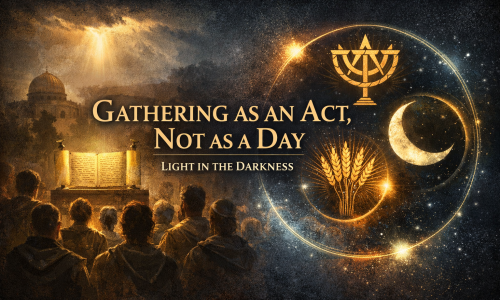
Gathering as an Act, Not as a Day
This study examines sacred time across the Torah and the Qur’an, focusing on underlying structures rather than later religious traditions.
Thesis
The Qur’an does not introduce a new sacred weekly day. Rather, it regulates the liturgical act of gathering (jumuʿah) within an already established system of sacred times inherited from the Torah and the Prophets. The gathering is an event grounded in sacred time, not a calendrical label assigned to a weekday.
1. Continuity of Revelation: Confirmation, Not Innovation
The Qur’an presents itself as a confirmation and criterion (muhaymin) over previous revelations. This presupposes an audience already familiar with concepts such as the Sabbath, sacred convocations (miqra qodesh), and rest from ordinary activity. Consequently, the Qur’an does not reconstruct a calendrical system, but regulates conduct within an already recognized sacred framework.
2. The Semitic Basis of Gathering: Miqra / Qara
In Hebrew, miqra (מִקְרָא) denotes a “called” or “summoned assembly,” derived from the root q-r-ʾ, meaning “to call,” “to proclaim,” or “to read aloud.” Such assemblies are associated with the Sabbath, the New Moon, and the appointed times (moedim), and presuppose public proclamation and communal hearing.
The Arabic verb qaraʾa occupies the same Semitic semantic field of public recitation and proclamation. Within this framework, jumuʿah designates a gathering for remembrance and proclamation, not the naming of a new weekday within a fixed weekly calendar.
3. Qur’an 62:9–11: Regulation of an Act, Not of a Day
Qur’an 62:9–11 commands a cessation of trade when the call to gathering is made and permits dispersion once the liturgical act has concluded. Critically, the text:
- does not designate a new sacred day,
- does not define the duration of a “holy day,”
- does not command a return to commercial activity as an obligation.
Instead, it regulates behavior during the act of gathering itself. This mirrors the prophetic critique found in texts such as Amos and Nehemiah, where commercial activity is incompatible with sacred assemblies, without redefining the underlying calendar.
4. Ezekiel 46 and Leviticus 23: Sacred Times Beyond the Weekly Cycle
Ezekiel 46 explicitly distinguishes the Sabbath and the New Moon as sacred times during which the “gates are opened,” while the “six working days” remain distinct. This demonstrates that:
- the New Moon is not part of the weekly cycle,
- multiple sacred times exist, each serving a specific function.
Leviticus 23 unites these times under the designation miqra qodesh (“holy convocations”). The unifying principle is not the name of a weekday, but the function of sacred time: gathering, proclamation, and rest.
5. Cycles and Sacred “Resets”
The biblical conception of time is structured around cyclical resets:
- Weekly: the Sabbath — reset of labor,
- Monthly: the New Moon — reset of the month,
- Annual: the Moedim — resets of the yearly cycle,
- Historical: the Jubilee — reset of social and economic order.
Each reset is accompanied by cessation from ordinary activity and communal gathering. The Qur’anic concept of gathering integrates seamlessly into this established pattern.
6. Conclusion
- The Qur’an does not introduce Friday as a new sacred day.
- Jumuʿah denotes a liturgical act of gathering, not a calendrical weekday.
- The regulation in Qur’an 62:9–11 continues the prophetic pattern of suspending commerce during sacred assemblies.
- Sacred times are functional and cyclical (weekly, monthly, annual), not fixed to solar weekday labels.
The gathering is an act within sacred time, not a day in itself.
Methodological Note
Some interpretations equate Qur’an 62 with Qabbalat Shabbat (the rabbinic reception of the Sabbath on Friday evening). This identification is methodologically unsound. Qabbalat Shabbat is a post-biblical rabbinic development, absent from the Torah and the Prophets. Moreover, Qur’an 62 presupposes the interruption of active trade, which logically implies a daytime context, not an evening period when commerce has already ceased. Reading later rabbinic liturgy into the Qur’anic text therefore represents a traditional imposition rather than a textual conclusion.