
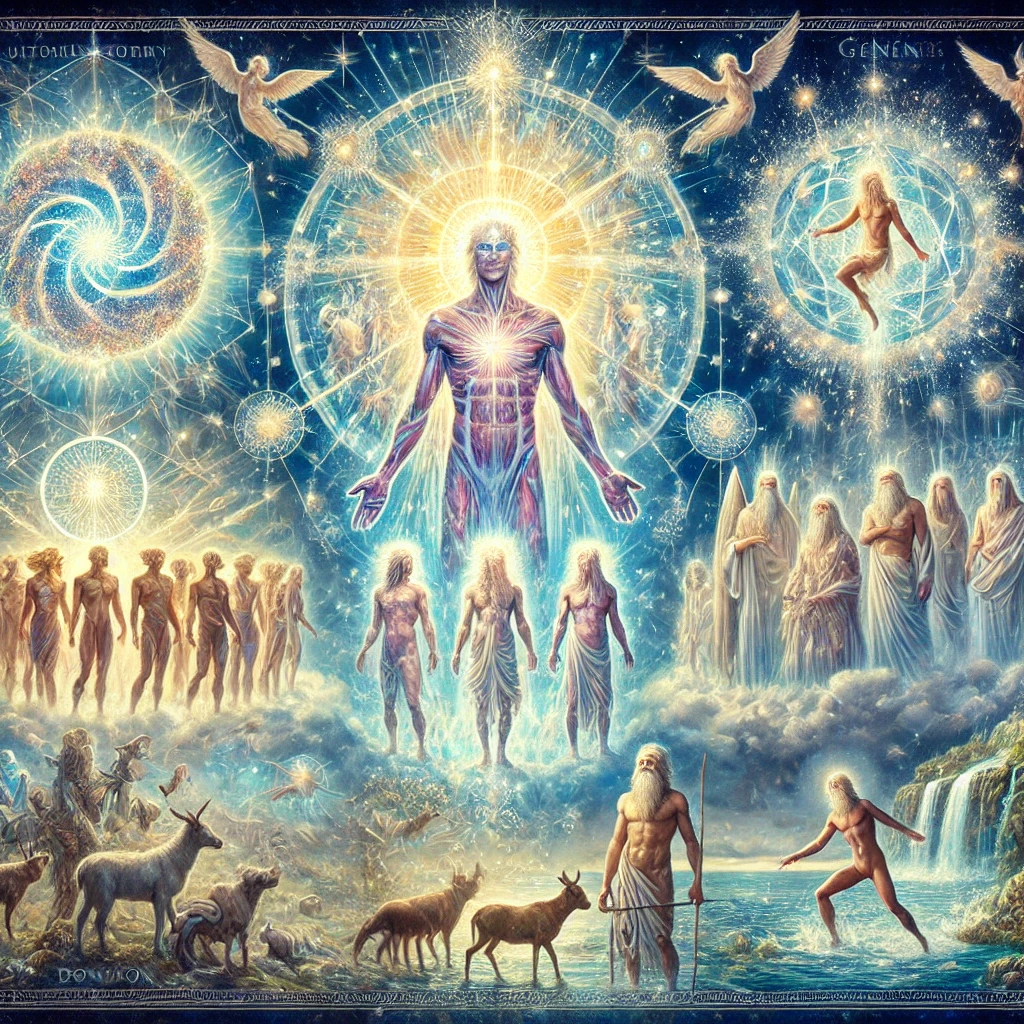
Religious texts often present profound ideas in ways that challenge surface-level interpretations. One recurring element that has perplexed readers is the use of the plural "We" in reference to divine actions. For some, this is explained as a "royal plural," while others view it as evidence of a deeper theological reality.
This lecture explores the concept of "We" in the Qur'an and other scriptures, distinguishing between the Creator, divine beings, and their roles in the cosmos.The Plural "We" in the Qur'an: A Question of Royalty or Delegation?
In the Qur'an, the term "We" frequently appears in verses describing acts of creation, revelation, and judgment. For instance:
"We said, 'Strike the [body] with a part of [the cow]': thus Allah brings the dead to life and shows His signs so that you may understand" (Surah Al-Baqarah 2:72-73).
At first glance, one might interpret "We" as Allah Himself. However, a closer examination reveals a distinction: the verse clarifies that Allah is the One who brings the dead to life. This suggests that the plural "We" refers to those who act under divine authority—likely angels or messengers—while the ultimate power remains solely with Allah.
A compelling example comes from verses where the speakers swear:
"By your Lord, We will gather them..."
Here, "We" swears by "your Lord," indicating that the speakers are not Allah but beings who recognize and serve Him. Thus, the "We" represents a delegation of authority, not a royal plurality. This aligns with the broader Qur'anic principle that Allah delegates tasks to His creation while retaining supreme sovereignty.
Elohim in the Hebrew Scriptures: Divine Beings or The Creator?
The Hebrew Bible introduces another plural term, Elohim, often translated as "God" but also applied to divine beings, angels, and even humans with authority (e.g., Moses in Exodus 7:1). A striking example is Psalm 82:
"God [Elohim] stands in the assembly of El; among the gods [elohim], He renders judgment."
Here, Elohim refers to multiple beings standing in the presence of El, the Supreme God. This reinforces the idea that Elohim often describes powerful beings who act under divine authority but are distinct from The Creator. This interpretation resolves many apparent contradictions in translation.
When Genesis 1 describes Elohim creating humans in their image, the plural pronouns ("Let us make man in our image") suggest a collective of divine beings. Yet the narrative affirms that the ultimate Creator is singular and transcendent, distinct from the Elohim mentioned elsewhere.
Kolbrin Wisdom: The Great God and the Lesser Gods
The Kolbrin Bible offers further clarity on this topic. In several passages, it distinguishes between The Great God—the Creator of all—and the lesser gods, who act as His limbs and servants. For example:
"The lesser gods are no more than His members. Hidden behind all these is another God. This God came into existence before all else." (GLN:8:5)
This parallels the idea found in the Qur'an and the Bible that divine beings, while powerful, are not the Creator Himself. They carry out His will, yet they remain subordinate, bound by His laws.
Zoharic Insights: Elohim as Manifestations
The Zohar, a central text of Kabbalistic thought, distinguishes between Elohim and the Ein Sof, the infinite and unknowable Creator.
- Elohim as the Emanation of Judgment: Elohim operates within the Sefirot, the divine attributes, particularly Gevurah (Judgment). These are emanations, not the essence of the Creator.
- Ein Sof: The Ein Sof is beyond comprehension, form, and plurality, existing as the source of all creation. Elohim serves as a bridge between the infinite and the finite. Delegated Authority in Action The concept of delegated authority is not unique to the divine realm.
Humans, too, are granted authority over creation:
"Let them have dominion over the fish of the sea, and over the birds of the air, and over every living thing that moves on the earth." (Genesis 1:26)
This dominion mirrors the authority granted to angels and other divine beings. Just as humans are accountable to The Creator for how they exercise their stewardship, so too are the Elohim and other messengers responsible for fulfilling their divine tasks.
Jacob's Encounter with Elohim and the Angel The account of Jacob wrestling with "Elohim" in Genesis 32:24-30 is often cited as a profound spiritual encounter. Jacob is said to have wrestled with a man, later identified as Elohim, and declares,
"I have seen God face to face, and yet my life has been spared."
However, Hosea 12:3-4 clarifies that Jacob's opponent was actually an angel,
"In the womb he took his brother by the heel, And by his strength he strove with elohim. So he strove with an angel, and prevailed; He wept, and made supplication unto him; At Beth-el he would find him, And there he would speak with us"
This distinction demonstrates that while the term "Elohim" can refer to the Creator, it is also applied to His messengers or agents, who act on His authority. This reinforces the view that the term "Elohim" signifies authority or power rather than exclusively the Creator.
The narrative invites readers to discern the roles of divine representatives and to avoid conflating them with the One Supreme Being. The Redeemer from Egypt and the Lawgiver Similarly, in Exodus 23:20-23, God speaks of sending "an angel" before the Israelites to guard them and lead them to the promised land. This angel bears God's name and authority, but the text makes it clear that the angel is distinct from God Himself.
Stephen, in Acts 7:38, reiterates this distinction, describing the Law as delivered by angels and in Judges 2:1 we read:
“And an Angel of the Lord came up from Gilgal to Bochim, and said, I made you to go up out of Egypt, and have brought you unto the land which I sware unto your fathers; and I said, I will never break my covenant with you."
This further supports the notion that intermediaries, referred to as Elohim, acted on behalf of the Creator in delivering the law and redeeming the Israelites from Egypt. By acknowledging these distinctions, we can see that the biblical narratives often highlight the roles of divine messengers while upholding the unique sovereignty of the Creator.
This understanding helps resolve apparent contradictions and avoids the doctrinal pitfalls of deifying intermediaries.
Misinterpretations and Theological Confusion
The translation of terms like Elohim and the use of "We" in sacred texts have often led to theological confusion. Some have conflated divine beings with The Creator, leading to doctrines that equate lesser gods or messengers with the Supreme God. Others have dismissed the plurality as merely symbolic, ignoring the textual evidence of distinct roles within the divine hierarchy.
The Qur'an warns against such conflations:
"Do not associate with Allah any partners..." (Surah An-Nisa 4:48).
Similarly, the Kolbrin Bible critiques the arrogance of those who mistake their lesser gods for the Supreme Spirit:
"Though their god was a god above Earth, he was not the God of Mankind... He serves The Supreme Spirit but is not The Supreme Spirit." (SOF:13:19)
Conclusion:
Returning to the Light Understanding the plural "We" and terms like Elohim requires intellectual humility and a willingness to separate dogma from text. The scriptures consistently point to a transcendent Creator, distinct from the messengers and beings who carry out His will.
Recognizing this distinction allows us to approach the texts with clarity, uncovering the light hidden within their words.
The Creator of All, The Supreme Spirit, is beyond human comprehension, unbounded by time, space, or plurality. Yet, through His messengers—whether angels, prophets, or divine beings—He communicates with creation, guiding us toward the truth.
Let us strive to discern this truth, seeking the light in all scriptures and avoiding the shadows of misunderstanding.