
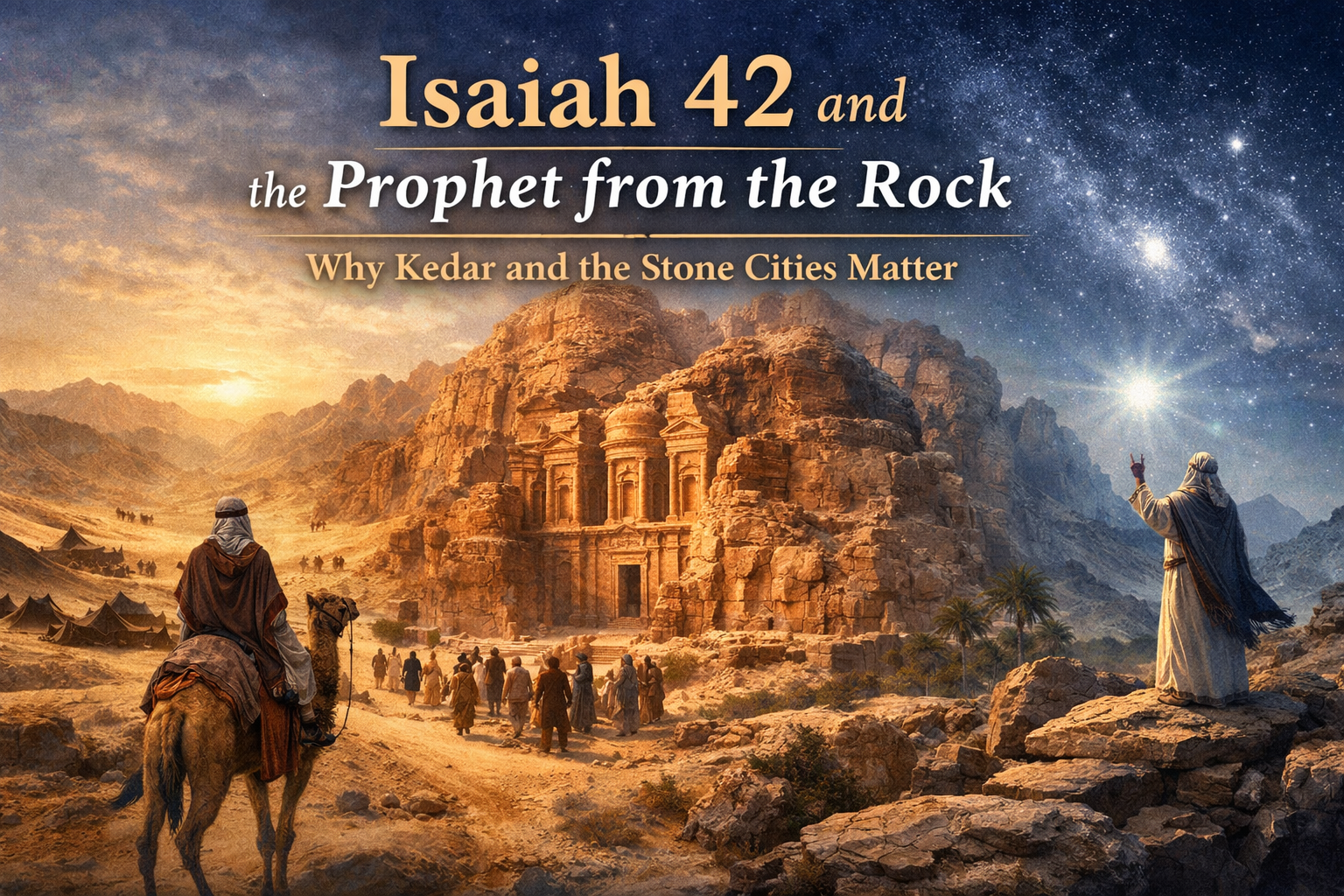
Isaiah 42 describes a servant sent not to a single nation, but to the nations. This passage has often been interpreted christologically by later theology. However, when read textually and historically — without doctrinal assumptions — the profile that emerges aligns far more naturally with Muhammad than with Jesus. This conclusion is based on function, outcome, and historical effect, not confessional preference.1
1) The Servant’s Mission in Isaiah 42
“He will bring forth justice to the nations… He will not grow faint or be crushed until he has established justice in the earth; and the coastlands wait for his law.”
(Isaiah 42:1–4)
Three elements are central to this description:
- Justice (mishpat) actively brought to the nations,
- Law (torah) awaited by distant peoples,
- Completion — the mission succeeds in history.
Isaiah is not describing an inward or purely spiritual reform. The text speaks of a servant whose mission results in a normative order affecting societies beyond Israel.2
2) Why This Description Does Not Fit Jesus Historically
Setting aside theology and later doctrinal interpretation, the historical Jesus:
- did not introduce a new legal system,
- affirmed the existing Torah rather than replacing it,
- did not govern or legislate for nations,
- did not establish a lasting juridical order.
His mission, as preserved in the earliest sources, was ethical, prophetic, and eschatological, directed primarily toward Israel. Identifying Isaiah 42 with Jesus therefore requires redefining “law” and “justice” away from their normal biblical usage.3
3) Why the Description Fits Muhammad Remarkably Well
In contrast, Muhammad’s historical mission aligns closely with the profile described in Isaiah 42:
- He arose among peoples associated with Kedar, outside Israel’s covenantal framework.4
- His message was explicitly addressed to peoples beyond a single ethnicity.
- His prophetic activity resulted in the establishment of a comprehensive legal and social order.
- That order was adopted by multiple peoples and regions, corresponding to Isaiah’s phrase “the coastlands wait for his law.”
Isaiah’s servant does not seek legitimacy through institutions or public agitation. Authority derives from divine commissioning rather than inherited power, a feature that corresponds closely to Muhammad’s prophetic posture.5
4) Geography Reinforces the Identification
“Let the wilderness and its towns raise their voice; let the settlements where Kedar dwells rejoice; let the inhabitants of the rock shout.”
(Isaiah 42:11)
The geographical markers in Isaiah 42 point to:
- desert-edge settlements,
- communities associated with Kedar,
- stone-dwelling populations.
This description corresponds to the Arabian–Transjordan frontier rather than to a Galilean or Jerusalem-centered mission. The text does not describe a temple-based reform, but a prophetic emergence from the desert–rock interface.6
5) Conclusion
When Isaiah 42 is read on its own textual and historical terms, the servant it describes is a figure whose mission brings law, justice, and order to the nations. This profile aligns poorly with the historical ministry of Jesus, but aligns strikingly well with Muhammad.
This conclusion is not theological polemic. It follows directly from the language of the text: justice, law, nations, and historical completion.
Footnotes
- Isaiah 42 consistently frames the servant’s role in relation to nations, not solely Israel, distinguishing it from earlier prophetic missions.
- The Hebrew terms mishpat (justice) and torah (law) normally denote concrete normative order, not abstract moral sentiment.
- See Matthew 5:17 and related passages affirming continuity with the Torah rather than the establishment of a new legal system.
- Kedar appears in the Hebrew Bible as a northern Arabian tribal entity interacting with the Levant (e.g., Genesis 25:13; Isaiah 21:16–17).
- Muhammad’s authority was explicitly grounded in revelation, not in priesthood, monarchy, or inherited institutional power.
- “Inhabitants of the rock” implies stone-based settlements, a description well attested in southern Transjordan and Nabataean contexts, but absent from Meccan archaeology.