
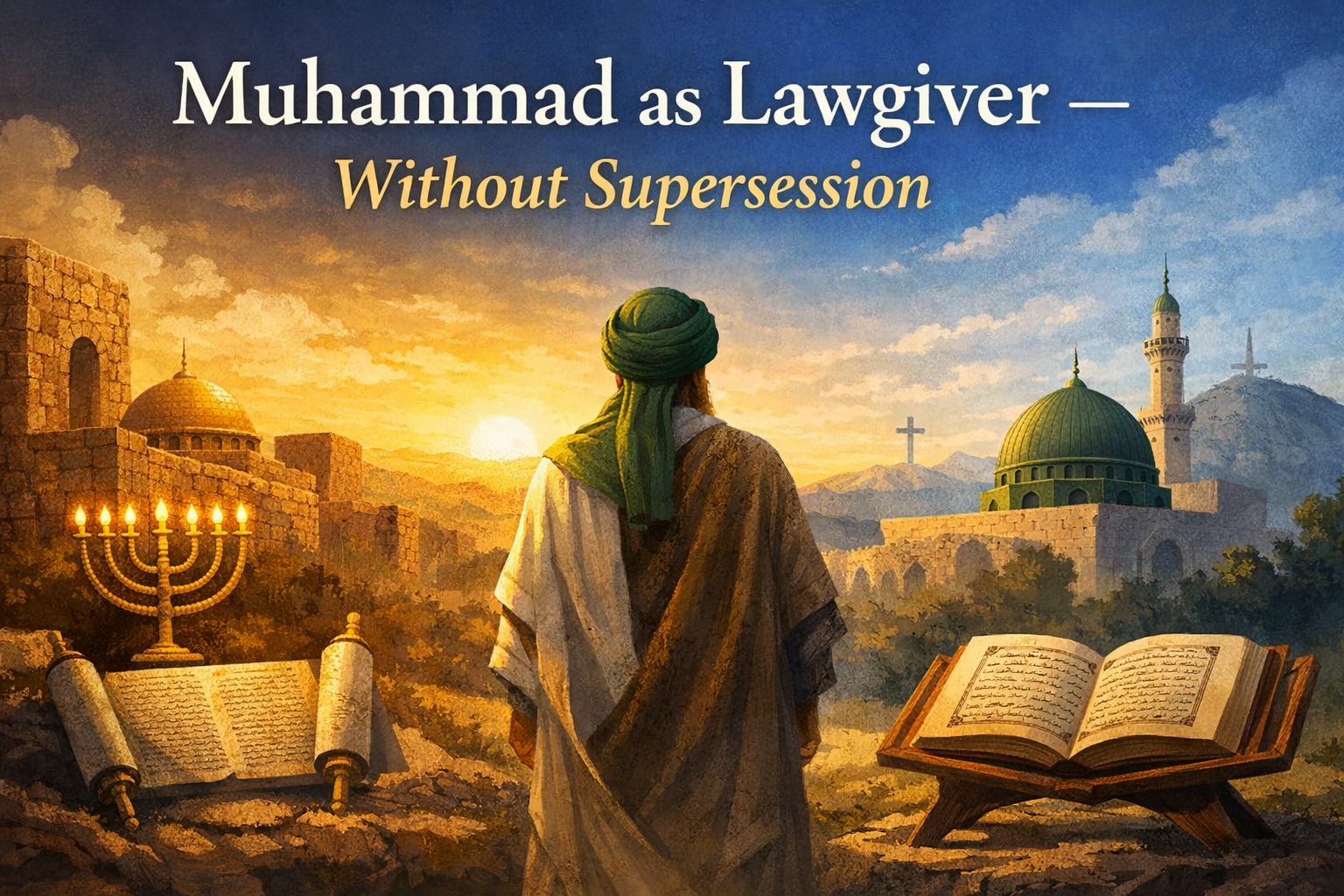
Muhammad as Lawgiver — Without Supersession
Authority does not require silent cancellation of prior divine covenants
A common claim says: if Muhammad was sent to all humanity, then his law must automatically bind all humanity, and prior divine covenants are therefore implicitly revoked. This assumption is often treated as self-evident, yet it is not established by explicit text in the Qur’an, nor does it follow from the broader scriptural pattern.
This article does not deny Muhammad’s authority, nor does it demote him to a mere preacher. The Qur’an presents him as a law-giving messenger for the community addressed by the Qur’an. The argument here is about scope, not authority.
The central distinction is simple: authority ≠ universal scope. Affirming Muhammad’s authority to bring binding commandments for his addressed community does not require the additional claim that he silently cancels God’s covenants with other communities without explicit text.
Jesus and Torah: Proper priorities and spirit, not abolition
In the Gospels, Jesus does not appear as a “Torah abolisher,” but as one who restores Torah’s priorities and inner purpose. His critique targets hypocrisy, formalism, and selective obedience—not the Law itself. The statement “I have not come to abolish the Law, but to fulfill it” signals continuity rather than rupture.1
In other words, a model already exists within earlier scripture for prophetic authority without abrogation: correcting practice, restoring meaning, and re-ordering priorities—without claiming that God’s prior covenant has been nullified.
Muhammad as lawgiver—But for whom?
The Qur’an portrays Muhammad as a messenger who warns, brings good news, confirms what came before, and delivers a Book for those who did not previously receive a Book. Yet universality of message does not automatically entail universality of legal jurisdiction. The Qur’an itself recognizes covenantal plurality and differentiates communities by their divinely assigned paths and responsibilities.2
Thus, Muhammad can be affirmed as a genuine lawgiver—for the community to whom that law is addressed—without asserting that other covenants are revoked by implication.
The error of universalizing law from a universal message
The core mistake in supersessionist readings is an extra assumption:
If a messenger is universal, then his law must be universal—and prior covenants must be cancelled.
But this is not a textual conclusion; it is a later theological construction. A message can be universal in call and accountability (God, truth, justice, the Last Day) while legal systems remain covenant-specific. The Qur’an explicitly speaks of communities receiving differing laws and ways, which breaks the automatic “universal messenger = universal law” equation.2
The problem of “silent abrogation”
If one claims Muhammad’s authority entails the automatic cancellation of previous divine covenants, a serious question follows: Where is the explicit revocation?
Across scriptural patterns, covenantal changes are announced, justified, and explained. A “silent cancellation” is not how divine covenants are normally handled. If God revokes obligations, the text declares it—silence is not revelation.
Limiting supersession is not diminishing prophethood
A predictable objection is that refusing supersession “demotes” Muhammad. But the objection confuses precision with reduction. Saying that Muhammad’s law does not revoke other covenants:
- does not deny his authority,
- does not deny his role as a lawgiver,
- does not deny the universality of his message.
Instead, it preserves covenantal consistency and avoids forcing the text into a contradiction: multiple covenants can coexist under one God without requiring a hidden cancellation narrative.
Conclusion
Muhammad is a lawgiver—without supersession. His authority does not require the claim that prior divine covenants were silently cancelled. In fact, restricting supersession to what is explicitly stated preserves the integrity of the Qur’anic framework and the wider scriptural pattern of covenantal clarity.
The problem is not the Qur’an. The problem is the later move that turns a universal call into universal legal domination. Authority without abrogation is not weakness; it is covenantal coherence.
Footnotes
- Matthew 5:17 (Jesus on the Law and the Prophets). ↩
- Qur’an 5:48 (recognition of distinct law/way for communities). ↩
- Qur’an 14:4 (messengers sent in the language of their people; scope and address). ↩
- Qur’an 2:62 and 5:69 (accountability and reward language applied across communities). ↩
- The Qur’anic concept of taṣdīq (confirmation) as a textual posture toward previous revelation. ↩
- On “silent abrogation” versus explicit covenantal declarations: compare the clarity of covenant framing in the Tanakh (e.g., Noahic, Abrahamic, Sinai covenants) with claims of implicit cancellation. ↩