
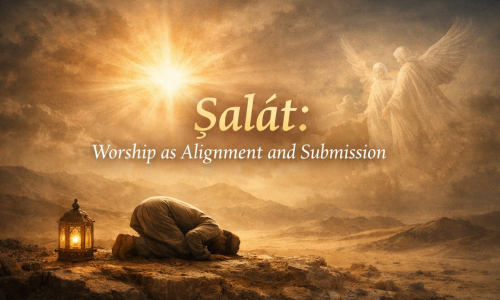
Ṣalāt: Meaning, Origin, and Continuity Across the Scriptures
From Ritualized Prayer to Alignment and Mandate
The term ṣalāt (صلاة) is one of the most central and yet most misunderstood concepts in the Qur’an. In later religious tradition, ṣalāt became almost exclusively identified with a fixed ritual performed at specific times. However, when examined linguistically, textually, and comparatively across Semitic languages and earlier scriptures, ṣalāt reveals a far deeper, older, and more functional meaning.
The Linguistic Root of Ṣalāt
The Arabic word ṣalāt derives from the root Ṣ–L–W / Ṣ–L–Y, whose semantic field centers not on ritual, but on orientation and relation. Core meanings associated with this root include:
- orientation toward
- connection and linkage
- following closely
- being aligned or positioned
- standing in relation to an authority
At its core, ṣalāt does not denote the recitation of words or the execution of prescribed movements. It denotes establishing and maintaining alignment — a sustained orientation of the human being within a recognized order.
Ṣalāt in Aramaic and Hebrew Context
The concept underlying ṣalāt predates Arabic and appears across earlier Semitic languages.
In Aramaic and Syriac, the cognate root ṣlā (ܨܠܐ) conveys meanings such as:
- to position oneself
- to stand in presence
- to orient oneself toward an authority
- to enter a relational stance
This usage does not inherently imply verbal prayer or ritual speech, but rather positional orientation and relational presence.
In Hebrew, while there is no direct lexical equivalent to ṣalāt, its functional parallels appear in concepts such as:
- ʿĀmad — to stand before (authority)
- ʿAvodah — service within an ordered relationship
- Tefillah — directed engagement rather than mere recitation
Throughout the Hebrew Bible, devotion is frequently described as standing before YHWH, emphasizing position, orientation, and accountability rather than formulaic speech. This reflects the same foundational idea preserved in the Qur’anic use of ṣalāt.
Ṣalāt in the Qur’an: Establishing Alignment
The Qur’an consistently speaks of establishing ṣalāt (iqāmat aṣ-ṣalāt), not merely performing it. This wording indicates continuity, structure, and maintenance of alignment, rather than a momentary ritual act.
Within the Qur’anic framework, ṣalāt encompasses:
- orientation toward divine authority
- ethical alignment and restraint from corruption
- recognition of accountability
- physical expressions that embody submission (standing, bowing, prostration)
These physical elements do not define ṣalāt; they manifest it.
“Establish ṣalāt, for ṣalāt restrains from immorality and wrongdoing.”
(Qur’an 29:45)
This verse alone makes it clear that ṣalāt cannot be reduced to outward form. A ṣalāt that does not shape conduct and character is incomplete by definition.
Ṣalāt Directed Toward the Messenger
A decisive clarification emerges when ṣalāt is used in connection with the Messenger:
“Indeed, God and His angels perform ṣalāt toward the Messenger…”
(Qur’an 33:56)
In this context, ṣalāt cannot mean ritual prayer, worship, or prostration. God does not perform ritual acts, angels do not worship a human, and the Messenger is never presented as an object of devotion.
The only meaning that remains coherent within the text is this:
Ṣalāt directed toward the Messenger denotes alignment with, support of, and affirmation of his mandate.
When attributed to God, ṣalāt signifies authorization and elevation.
When ṣalāt is directed toward the Creator, it denotes alignment and orientation toward divine authority; sujūd is the bodily act through which that alignment is physically acknowledged, but it does not define ṣalāt itself.
When attributed to the angels, it signifies participation and support within the order.
When commanded of believers, it signifies conscious alignment with the direction and responsibility carried by the Messenger.
Thus, ṣalāt functions as a term of mandate, backing, and positional orientation; toward the Creator, it constitutes worship in its relational, not mechanical, sense.
Ṣalāt as Alignment, Not Automation
When ṣalāt is detached from its original meaning, it degrades into mechanical repetition. This is precisely what both the Qur’an and earlier scriptures caution against.
Ṣalāt is therefore best understood as:
- a state of alignment before it is an act
- a relationship before it is a routine
- submission to order, expressed through body and conduct
Conclusion
Ṣalāt is not a Qur’anic innovation, nor merely a ritualized religious duty. It is an ancient Semitic concept denoting orientation, alignment, and participation within a recognized authority structure.
The Qur’an preserves this depth while providing embodied forms through which alignment becomes visible, disciplined, and lived — not as automation, but as conscious positioning before the Creator and within His order.