
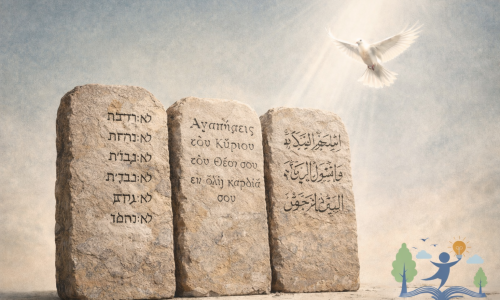
Does the Qur’an Abolish the Torah?
Why the Qur’an affirms covenant plurality rather than supersession
Introduction
The claim that the Qur’an abolishes previous covenants because Muhammad is described as a messenger to all mankind is not supported by the Qur’an itself, nor by the Tanakh, nor by the New Testament passages often cited in its defense.
This claim rests on an unexamined assumption: that universality of message automatically implies universality of law. The Qur’an explicitly rejects this assumption.
Universal Message Is Not Universal Law (The Qur’anic Distinction)
The Qur’an itself explains why Muhammad is sent to all mankind:
“Lest you say: The Book was only sent down to two groups before us…” 1
This passage makes three points unmistakably clear:
- Two groups already possessed revealed Books
- Other peoples did not
- The Qur’an removes the excuse of those without scripture
The Qur’an therefore fills a gap; it does not erase or invalidate prior grants. If Jews and Christians were meant to abandon their scriptures, this explanation would be incoherent.
The Qur’an Explicitly Preserves Covenant Plurality
The Qur’an does not merely tolerate covenant diversity; it theologizes it:
“For each of you We appointed a law (shirʿa) and a way (minhāj). If Allah had willed, He would have made you one community…” 2
This verse is decisive:
- Multiple laws are intentional, not accidental
- Unification is eschatological, not legal
- Replacement theology is explicitly denied
A universal messenger does not imply a universal legal system.
Jews and Christians Are Never Told to Abandon Their Law
The Qur’an repeatedly commands the opposite:
- “Why do they come to you for judgment while they have the Torah?” 3
- “The Torah is guidance and light.” 3
- “Let the People of the Gospel judge by what Allah revealed therein.” 3
- “You stand on nothing unless you uphold the Torah and the Gospel.” 3
These statements are logically incompatible with covenant abolition.
Covenant Breach ≠ Covenant Abolition (Jeremiah Misread)
Jeremiah 31 is frequently misused as a supersessionist prooftext. The chapter does not teach replacement:
- The covenant remains with Israel and Judah
- The same Torah is written on the heart
- The issue is obedience, not legal validity
This reading is confirmed by the closing voice of the Tanakh:
“Remember the Torah of Moses My servant…” 9
The Tanakh ends by reaffirming Torah, not canceling it.
Isaiah Already Describes a Universal Mission Without Abolition
Isaiah 42 presents a strikingly Qur’anic model:
- Justice (mishpat) goes to the nations
- The servant does not impose or coerce
- “The isles wait for his torah” — meaning instruction, not covenant transfer
Israel retains Torah; the nations receive guidance. This is not replacement but extension. 9
Where Abolition Theology Actually Comes From
The doctrine that “a final revelation cancels previous law” does not originate from:
- Moses
- The Prophets
- Yeshua
- James
- The Qur’an
It originates in Pauline theology, where the law is declared obsolete and replaced. This framework was later imported into Islamic theology despite contradicting the Qur’an’s own structure.
Common Objections Answered
1) “Doesn’t the Qur’an say Jesus changed Torah law?” (Qur’an 3:50)
Qur’an 3:50 places two statements in a single sentence:
- Jesus comes confirming what is before him of the Torah (muṣaddiqan limā bayna yadayya mina t-Tawrāt). 10
- He comes to permit for Israel some of what had been forbidden to them. 10
If the “forbidden” items were Torah commandments as such, the statement would collapse into contradiction: one cannot confirm a law while simultaneously abolishing that same law in the same breath.
The phrase baʿḍa alladhī ḥurrima ʿalaykum (“some of what had been forbidden to you”) therefore points to restriction and burden, not repeal of Torah.
This aligns with the Gospel critique of legal inflation and distorted priorities (e.g., Sabbath turned into an inhuman burden; extra purity accretions such as hand-washing traditions). The issue is not Torah vs. non-Torah, but over-extension, misapplication, and burdening of the law.
Related Qur’anic framing:
Qur’an 4:160 speaks of lawful goods being forbidden as a consequence of wrongdoing, which can be read as punitive severity and narrowing of allowance, not a denial of Torah’s status. 11
Conclusion: Qur’an 3:50 describes restoration and relief, not Torah abrogation.
2) “But the Qur’an explicitly teaches abrogation” (e.g., Qur’an 16:101)
Verses like Quran 16:101 are often misinterpreted as evidence of abrogation. However, even textually, they speak of the replacement of verses in the process of revelation, not of the tacit or explicit abrogation of other covenants — which the Quran does not explicitly teach. 12
A covenantal cancellation would require explicit statement that:
- the Sinai covenant has been revoked for Israel, or
- the Torah is no longer binding on the Children of Israel.
The Qur’an never states this. Instead it repeatedly affirms the continuing covenantal identity and responsibility of earlier communities.
3) “Does Qur’an 5:5 relax Jewish dietary law or intermarriage law?”
Qur’an 5:5 states:
- “The food of those given the Scripture is lawful for you, and your food is lawful for them.” 8
- “Chaste women from among the People of the Book are lawful for you (upon marriage).” 8
This is best read as permission of interaction, not cancellation of covenantal law.
Food: The verse removes an identity-based barrier to eating across communities; it does not state that what was forbidden to the Children of Israel is now permitted to them. The Qur’an elsewhere continues to recognize Jewish dietary prohibitions. 7 A legal repeal must be explicit, not assumed.
Marriage: The marriage clause is not reciprocal in the wording. It says lawful for you; it does not say “your women are lawful for them.” Therefore, it does not legislate Jewish halakhah; it legislates Qur’anic permissibility for the Qur’anic community.
Conclusion: Qur’an 5:5 opens social space without collapsing distinct covenantal obligations.
Historical Corroboration: Natan’el al-Fayyumi (12th Century)
This covenantal reading of the Qur’an is not a modern reconstruction. It appears explicitly in medieval Jewish thought.
Natan’el al-Fayyumi (12th-century Yemenite rabbi and philosopher), in his work Bustan al-Uqul (“Garden of Wisdom”), articulated a theology of prophetic plurality in which:
- God sends prophets to different nations
- Each nation receives laws appropriate to it
- These laws do not annul the Jewish Torah
Crucially, al-Fayyumi explicitly regarded Muhammad as a true prophet, sent by God to the Arabs, while affirming that the Torah remains binding upon Israel.
He grounded this view in the Qur’an itself:
“We sent a messenger only in the language of his people.” 13
Al-Fayyumi reasoned that had Muhammad’s law been intended for Israel, he would have been sent in their language. Recognizing Muhammad’s prophethood therefore does not require supersessionism.
Final Conclusion (Inescapable)
- The Qur’an universalizes accountability, not law.
- It confirms previous covenants and commands their followers to uphold them.
- It provides law to those who did not previously receive one.
- It explicitly rejects covenant replacement. 2
Supersession theology contradicts the Qur’an, the Tanakh, and the Prophets.
Therefore, the claim that the Qur’an abolishes previous covenants is not textual — it is dogmatic.
Notes and Scriptural References
- Qur’an 6:156–157. ↩
- Qur’an 5:48. ↩
- Qur’an 5:43–44, 5:47, 5:68. ↩
- Qur’an 40:53 (inheritance of the Book to the Children of Israel).
- Qur’an 2:40, 2:63, 2:83, 2:93; 4:154; 5:7, 5:12, 5:70; 7:169; 33:7; 57:8 (covenant / mīthāq emphasis).
- Qur’an 2:80 (principle: God does not break His covenant).
- Qur’an 6:146 (recognition of Jewish dietary prohibitions as valid).
- Qur’an 5:5 (permissions of interaction; food/marriage clause).
- Jeremiah 31; Malachi 4:4; Isaiah 42.
- Qur’an 3:50.
- Qur’an 4:160.
- Qur’an 16:101.
- Qur’an 14:4 (as cited in the al-Fayyumi argument).
“It is not important who writes, but what is written; not who says it, but what is said.”